
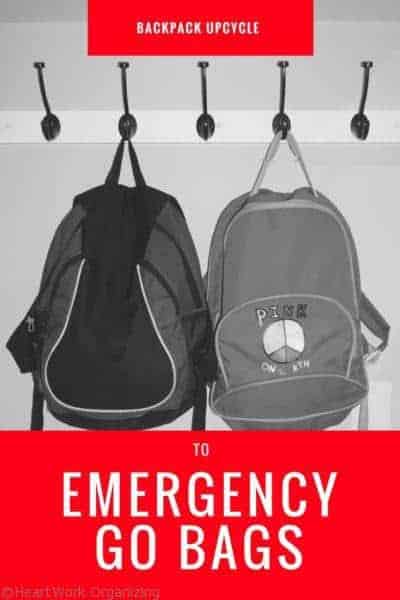
According to FEMA, only 33% of Americans have a Go Bag in their home or car in case an emergency forces you and your family to flee. For the rest of you (those in the 67% of unprepared families) this post has been created to help you stock this essential disaster emergency solution. Some families prefer a simple approach to having an emergency go bag for their family and that would be to purchase one online or at a local store. The problem with that strategy is that pre-made go bags are a ‘one-size-fits-all’ solution, which unfortunately, doesn’t fit every family. In addition, it may be cheaper to stock your own ‘go bag’ since many of the items you will want to put in your bag are already in your home. Here are some suggestions and advice on how to stock your family’s personal go bag(s):
The Quick Evacuation Go Bag is a bag that should be packed and ready to go when there is little advanced warning of danger and no time to assemble the contents. If wildfires, floods and other potential disasters such as earthquakes threaten your family, the quick evacuation go bag should be packed and placed near your bed or the front door. The bag can be a duffel bag, a backpack or a small carry-on bag. The contents of the quick evacuation bag assumes that you will be able to find food and water at the end of your evacuation location. So, the focus is on the comfort and safety of your family. Recommendations include:
- A flashlight (with extra batteries).
- An old pair of sneakers for each family member (to protect your feet).
- A warm sweater or jacket.
- A whistle or non-electronic noise maker (in case you are trapped).
Go bags are not only useful for evacuations. They are also a resource for times when you decide to shelter in place in your home. If a power outage occurs or a ‘stay-at-home’ mandate is issued, your go bag can provide essentials for surviving in your home when you are unable to use your refrigerator, your stove, your electricity and other household appliances. Here’s the shortlist for stocking a more complete go bag:
- Non-perishable food for three days.
- Water in containers for three days. One gallon per day per family member since your tap water may not be available during those three days.
- Clothing to keep you warm and dry for three days (also good for evacuations).
- Proper medications for all family members for 3 days.
- Identity and important proof papers stored electronically in the cloud or uploaded on a thumb drive (or both).
Identity and important papers proof are often a forgotten addition to a go bag. Can you imagine having to prove you own something (for insurance claims) or who you say you are if you don’t have access to that proof in your home? Here’s a short list of those important papers and identity items that should be accessible because you took the time to copy those items to a thumb drive in your bag or you uploaded them into the cloud:
- Proof of homeowner’s insurance or flood insurance.
- Health insurance information for each member of the family.
- Copies of your passports.
- A secure list of passwords to important websites and vendors.
- Copies of birth certificates and marriage licenses.
- A list of your home’s contents or better yet, multiple images of every room in your home.
Let’s not forget the reality of leaving your home with only the items in your go bag. How would your family pass their time for hours, even days without something to occupy their time. Why not add a deck of cards, a Bible, a book (for each family member) or a small card game like Uno into your go bag? Bottom line is that a go bag is never a ‘one-size-fits-all’ solution. Your go bag or go bags depends on the composition of your family, whether you have pets or not, how much time you have to gather your items and whole lot more. So, start preparing now with at least a Quick Evacuation Go Bag and then add more bags or more contents over the next weeks and months to make sure you will have everything you need should you need to or be forced to ‘Go!’