
Here’s the situation – danger to your family is imminent. Some of your family members are not at home or are dispersed in your community. What steps can you take to ensure that you can contact dispersed family members and provide them with recommendations on how to avoid the approaching or current danger? A family communication plan that is in place and discussed in advance of a dangerous situation is what every family should have for these situations. Situations like a tornado warning, an approaching wildfire, a water control structure (dam or levee failure), hazardous material spill and much more. So how do you start creating your family’s Key Contacts List? It’s the first step in establishing a family communication plan.
Key Contact Lists can be as simple as having an Emergency Contact List to having a robust communication plan with optional methods of communicating that have been tested and practiced by all family members. This post is all about completing the basics. Every family should have essential household information and designated meeting places pre-determined. Below is an image from the Ready.gov website of the basic household Information every family should have.
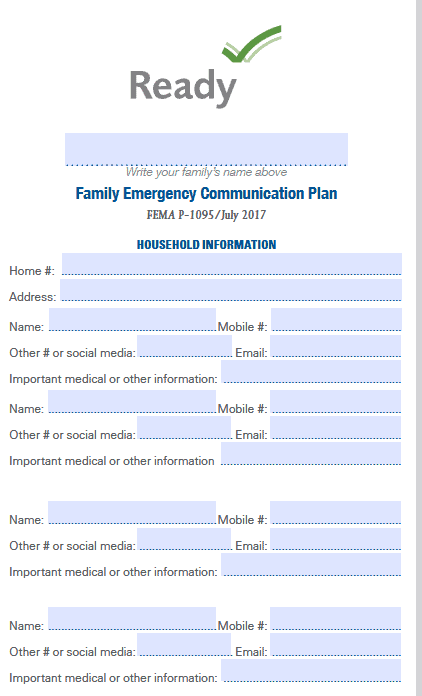
Fill out the information in this example, create copies for every family member and be sure the copies are always stored in a member’s wallet or purse or backpack. In addition, you should also post a copy in your home (on the refrigerator or a family bulletin board).
The second part of this ‘basic’ Key Contacts plan is to pre-determine where potential meeting places will be if an emergency occurs. These pre-determined meeting places are NOT where all family members should meet. Rather, these pre-determined meeting places should be locations that an individual family member could go for safety if they are not at home. It should include three locations: a recommended indoor location, a neighborhood location and an outside of your neighborhood location. Indoor location examples are your home or basement, a closet or bathroom or a storm shelter. Neighborhood locations could be anything from a neighbor’s house to a big tree, or the end of the driveway or street. An outside-of-the neighborhood location might be a church, a local library, a family friend’s house, etc.
There are additional steps a family can take to develop an enhanced family communication plan. You can gather additional safety location information such as potential school, workplace or local government buildings that might provide shelter for a family member. You can also have alternative contact devices in place in case cell phone coverage is overwhelmed before or during a disaster. And then there is the practice of testing your communication plan where family members call in and report their safe location to parents or an individual member can request guidance on where to shelter, if need be.
At https:/family-preparedness.com we have tiny courses, 10 question quizzes and other essential advice on how a family can create their own emergency communication plan. These tools will help you determine if your family needs a basic or a more robust communication plan. The safety of your family depends upon your preparation and practice of this essential family safety process. Be prepared. Don’t delay. Spend an hour or so getting ready for this critical plan.