
Here are the risks involved for families that do not have a car emergency safety plan:
- The roads away from a pending or current disaster may be backed up with thousands of people trying to evacuate at the same time.
- Gas stations may be overwhelmed or closed because they only have so much gas for thousands of people trying to evacuate at the same time.
- The distance you may need to travel to find a hotel room(s) may be significant so your family may need to spend a night sleeping in your car.
- If your solution is to have one or two five-gallon containers of gasoline in your car trunk, you are increasing your family’s danger risk if your car is back-ended.
Every family should have the goal of deciding to ensure that one of your cars is a reliable tool for escape. You never know if an escape plan will be used. My family was evacuated during a flood in 1982 by the National Guard. They knocked on our door and told us we had five minutes to gather our items and go with them on their military truck. Our vehicles and everything we owned were left behind.
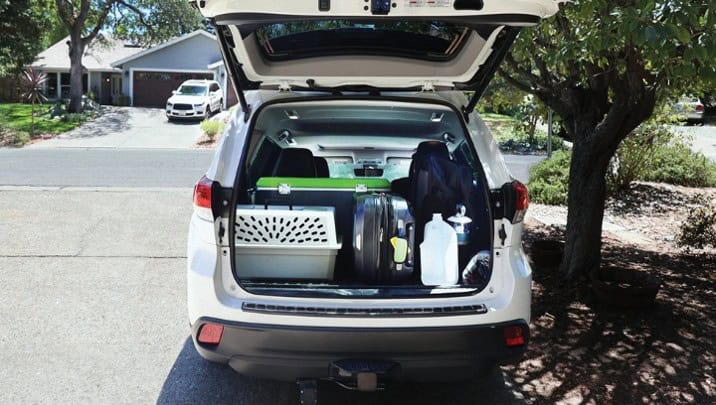
So, here are a few recommendations to help you develop a good car emergency safety plan so you can evacuate on your own:
- Install new windshield wiper blades or refresh your current ones. (Use a paper towel moistened with window cleaner to refresh the blades.)
- Check your tire pressure before you leave. You do not want a flat tire to hold you back. Streets may be littered with debris, and the chance of a puncture can be greater. To be safe, check your spare to make sure it is ready and/or have a can of fix-a-flat sealant in your trunk.
- Pack a go bag for each member of the family and do not forget to add or bring your family members’ medications.
- Bring cash. ATM’s may be out of cash or have no power.
- Bring physical maps of the region. Your phone battery could die, or you may not get a cellular signal from overwhelmed cell towers. Your usual map apps may not be available.
- Pack an extra cell phone charger that you can plug into your car.
- Purchase a battery-jump starter and keep that in the trunk. Useful for starting a car battery plus it can also recharge portable devices like mobile phones and tablets. You can purchase these for $40 at Walmart, up to $125 for high-quality ones on Amazon.
Here are some suggestions for creating a car emergency safety evacuation plan on steroids:
- Document what you own in case you may not be able to get inside your home for weeks or months. Take pictures or videos of each room in your home to prove ownership to insurance companies.
- Do not forget to take pictures of your cars (inside and out) if you need to file a future car damage insurance claim.
- Make sure all windows and the sunroofs are closed if you are leaving one or more of your vehicles at home.
- Keep a copy of your car insurance paperwork in a zip-lock bag inside your go-bag. If your car is damaged, use your insurance info to book a repair immediately since local repair shops will quickly be booked up.
- Avoid taking route shortcuts. They are more likely to cause problems like trees down, flooding and are usually the last roads for emergency workers to clear.
- If you are leaving one of your cars behind, park it sideways in from of a closed garage door. This will help protect the garage contents and the car.
Our website (https://family-preparedness.com) has several tools to help your family prepare for situations where your safety is dependent upon having your vehicle and your evacuation plans in place. Check out our ‘How to Prepare’ section of the website for information on planning an evacuation, plus dozens of blog posts that can help your family prepare. In addition, we have short, tiny courses that you can complete in about ten minutes. They include an evacuation plan tiny course, an asset protection plan tiny course and an emergency car kit tiny course. The courses are only $27 each and well worth the time and the investment. Check out our tiny courses here. Or learn how to prepare by subscribing to receive preparedness recommendations from our weekly blog here.